
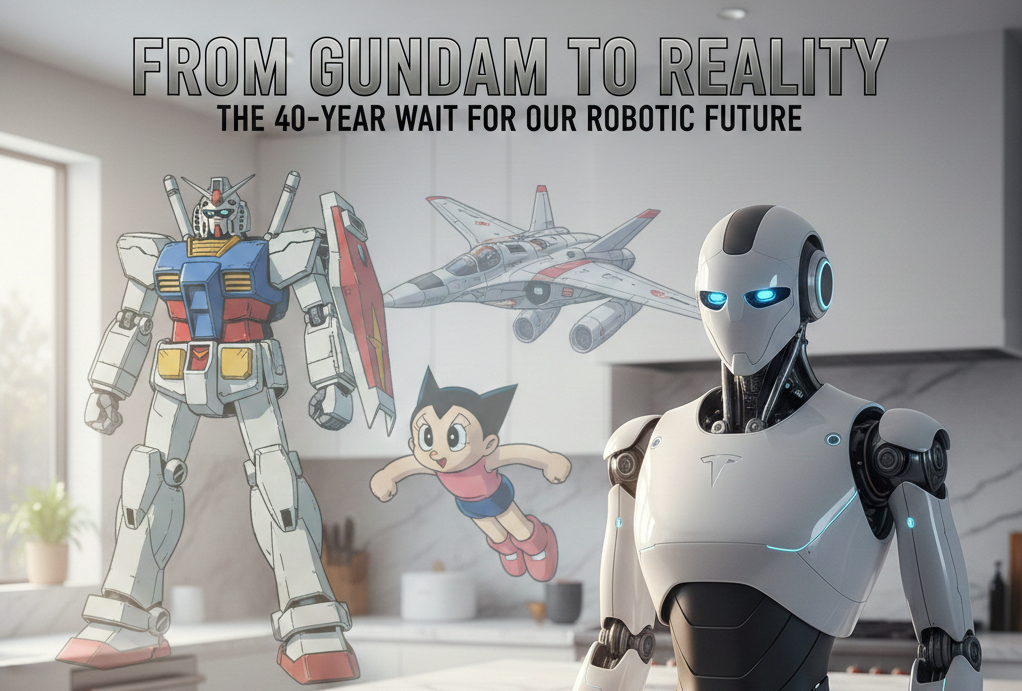
Growing up in the 1980s and 1990s, many of us were raised on Japanese animations filled with intelligent robots. From Astro Boy to Gundam, from friendly helpers to thoughtful machines struggling with morality, these stories shaped our expectations of the future. Robots were not just metal tools; they had minds, personalities, and sometimes even souls. As kids, we genuinely believed that by the time we became adults, such robots would be walking beside us in everyday life.
That future, however, took far longer than we imagined.
More than forty years later, something remarkable has finally happened: we have built a kind of “brain” for machines. Artificial intelligence—especially in the last decade—has made dramatic progress. Machines can now recognize speech, understand images, translate languages, drive cars, diagnose diseases, and even hold conversations that feel surprisingly human. In many ways, the intelligence we once saw only in animation is now real.
Yet the robots themselves are still missing.
This contrast is striking. While AI software has advanced at an exponential rate, physical robots remain clumsy, expensive, fragile, and limited. A chatbot can write poetry or solve complex problems, but put that same intelligence into a humanoid body and suddenly everything becomes much harder. Walking on uneven ground, grasping delicate objects, adapting to unpredictable environments—these tasks are trivial for humans and animals, but incredibly difficult for machines.
The reason lies in the difference between intelligence and embodiment. Intelligence, it turns out, is easier to simulate than physical interaction with the real world. The world is messy. Objects vary in shape, texture, weight, and behavior. Humans unconsciously process enormous amounts of sensory data to move naturally and safely. Teaching a robot to do the same requires not just smart algorithms, but also advanced sensors, precise motors, durable materials, efficient energy systems, and real-time decision-making under uncertainty.
Energy is another major obstacle. Human bodies run for hours on a simple meal. Robots often require heavy batteries, frequent charging, or external power sources. Until energy storage becomes lighter, safer, and more efficient, truly autonomous robots will remain limited.
So when will intelligent robots become part of our daily lives?
The answer is not a single moment, but a gradual transition. In fact, it has already begun—just not in the way our childhood animations suggested.
Robots are quietly entering controlled environments first: factories, warehouses, hospitals, farms, and laboratories. These spaces are structured, predictable, and optimized for machines. Robotic arms assemble products, autonomous vehicles move goods, drones monitor crops, and surgical robots assist doctors. These are not humanoid companions, but they are real, practical, and economically valuable.
The next step is service robots designed for semi-structured environments: homes, offices, and public spaces. Vacuum robots, delivery robots, and warehouse pickers are early examples. As AI improves perception and learning, these machines will become more adaptable and useful.
Humanoid robots—the kind we dreamed about as kids—will likely arrive last. Not because they are impossible, but because they are unnecessary for many tasks. Wheels are often better than legs, and specialized tools outperform human-like hands. When humanoid robots do become common, it will be because they fit into human-designed spaces without requiring massive redesign.
Realistically, we may see limited but meaningful humanoid robots in everyday life within the next 10 to 20 years: assistants in elderly care, reception roles, maintenance tasks, or hazardous environments. Fully general-purpose robots—capable of doing almost anything a human can—will take longer.
In a way, our childhood predictions were both wrong and right. We expected robots to arrive quickly, but underestimated the complexity of the physical world. At the same time, we did not imagine that intelligence would first appear without a body—living in screens, clouds, and devices.
The robots of our anime dreams are no longer science fiction. Their minds are here. Their bodies are catching up. And when the two finally mature together, the future we once watched on TV will quietly step into our daily lives—not with dramatic music, but with practical usefulness and profound impact.




EmailBombEn
<a href=https://t.me/Flood_email_bot>email spam bomb threat</a>
(Info Email bomber https://t.me/flood_service/465 )
Email Bombing - email flood or email hoax (DOS attack) or cluster email bombing, what are they actually doing?
A huge number of emails are sent to e-mail. This usually means that the @Flood_email_bot specifically targets the victim's mailbox associated with your email.
These emails are intended to make fun of friends or distract the victim from any security messages or other emails.
I am glad to present you a mail flood bot with a convenient menu and flexible settings!
The cost of the service is $ 1 = 1000 letters.
You specify the time of the flood and the number of letters yourself, or choose the "FAST FLOOD" function
During the flood, a sufficient number of letters arrive so that the owner would miss an important letter!
The bot will flood more than you ordered. On average, 30% more than ordered.
FLOOD EMAIL | EMAIL SPAM FLOOD GMAIL | ALL EMAIL FLOOD | ФЛУД ПОЧТ | Бот по флуду почт | Спам почт | spam mail | email flooder | Поставить флуд на почту | Топовый флудер почт | Флуд емаилов | Новый телеграм бот по флуду почт
Flood email, Floods Email, Email flooding, gmail flood, email bomber, flood hotmail, flood online,email flooding, email flood bot, email flooded with spam, email flooding service, email flooded with subscriptions, email flooder bot, email bomber 2023, email bomber 2024, email spam bot online, email spammer bot free, spam bot, бот по флуду почт, сервис по флуду почт, услуги по флуду, флуд услуги.
@Flood_email_bot - Лучший емаил бомбер на рынке!